Die Inhalte auf unserer Website werden ausschließlich zu allgemeinen Informationszwecken bereitgestellt. Sie sollten weder als Beratung oder Empfehlung für den Kauf, Verkauf oder Handel von Produkten oder Dienstleistungen betrachtet werden, noch sind sie dafür bestimmt. Wichtig ist, dass die bereitgestellten Informationen kein Verkaufsangebot oder eine Aufforderung zum Kauf eines beliebigen Produkts darstellen.
Bitte beachten Sie, dass die Verfügbarkeit unserer Produkte aufgrund behördlicher Vorschriften oder anderer Faktoren in den verschiedenen Märkten variieren kann. Daher sind möglicherweise nicht alle Produkte oder Dienstleistungen in Ihrer Region oder Ihrem Land verfügbar. Bei konkreten Fragen zur Verfügbarkeit und Preisgestaltung einzelner Produkte kontaktieren Sie uns bitte unter sales@noctiluca.eu.
Spezifikation
-
Name:
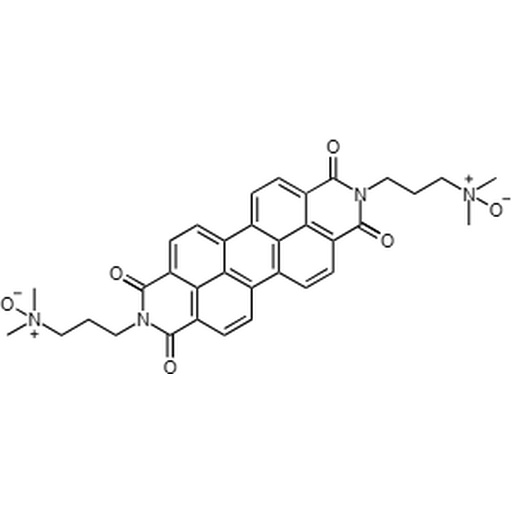
PDINO
-
Vollständiger Name:
N,N'-Bis(N,N-dimethylpropan-1-amine oxide)perylene-3,4,9,10-tetracarboxylic diimide
-
CAS-Nummer:
1558023-86-1
-
Chemische Formel:
C34H32N4O6
-
Molekulargewicht:
592.64 g/mol
-
Absorption:
λmax = 468 nm in film
-
Photolumineszenz:
N/A
-
HOMO/LUMO:
HOMO = -6.2 eV, LUMO = -3.6 eV
-
Synonyms:
PDI-NO, 3,3'-(1,3,8,10-Tetraoxoanthra[2,1,9-def:6,5,10-d'e'f']diisoquinoline-2,9(1H,3H,8H,10H)-diyl)bis(N,N-dimethylpropan-1-amine oxide)
-
Klassifizierung:
Organic semiconducting materials, Small molecule electrolyte, Cathode interlayer materials
-
Reinheit:
98% (1H NMR)
-
Schmelzpunkt:
TGA: 103 °C (5% weight loss)
-
Aussehen:
Reddish brown powder/crystals
PDINO: The Pinnacle of Cathode Interlayer Materials in Organic Electronics
In the dynamic world of organic electronics, PDINO emerges as a standout material. Its electron-deficient characteristics combined with its pivotal role as a cathode interlayer material underscore its significance in the ongoing progress of organic electronics.
Understanding PDINO
PDINO, scientifically known as N,N‘-Bis(N,N-dimethylpropan-1-amine oxide)perylene-3,4,9,10-tetracarboxylic diimide, is a unique compound that stands out due to its intricate molecular structure. PDINO is a compound featuring an amino N-oxide group attached to perylenediimide (PDI) with flat, electron-rich π-conjugated structures, serves as a frequently employed material for cathode interlayers.This specific arrangement grants PDINO its electron-deficient nature, a characteristic that plays a pivotal role in its applications in optoelectronic devices.
Key Features of PDINO
- Electron Transport in OLEDs and OPVs: Due to its π-electron structure (π-delocalised system) and high electron affinity, PDINO is an exemplary electron transport layer material in organic photovoltaic devices and OLEDs.Perylene-based compounds are known for their unique electronic and optical properties. They are often used in the development of organic semiconductors, dyes, and pigments.
- Cathode Interlayer Material: Its electron-deficient nature makes PDINO a preferred choice for cathode interlayer materials. PDINO-based devices perform well when high work function metals such as gold (Au) and silver (Ag) are used as cathodes. This versatility makes PDINO a practical choice for various photovoltaic applications, even those requiring specific cathode materials.
- Efficient Charge Collection and Versatile Compatibility: PDINO finds its application in organic solar cells, facilitating efficient charge transport and collection. It is compatible with various organic photovoltaic materials and allows for a wide range of interlayer thicknesses, resulting in high-performance photovoltaic devices.
The Role of PDINO in Advanced Organic Electronics
In the world of organic electronics, PDINO has carved a niche for itself, primarily as a cathode interlayer material. Its electron-deficient nature, coupled with its π-electron structure, makes it an ideal candidate for this role. Moreover, PDINO has shown compatibility with metals like Al, Au, and Ag when employed as a cathode, further expanding its utility.
Conclusion
The organic electronics industry is in a constant state of evolution, with materials like PDINO leading the charge. With its unique molecular structure and a plethora of beneficial features, PDINO is set to play a transformative role in the future of optoelectronic devices. As research continues and technology advances, it’s evident that PDINO will find even more applications, solidifying its position as a cornerstone material in organic electronics.