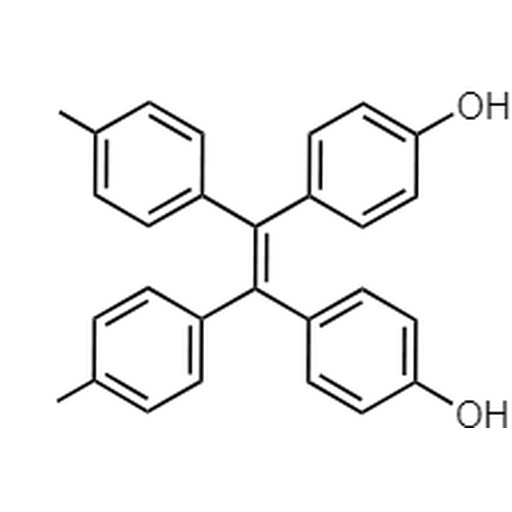
Die Inhalte auf unserer Website werden ausschließlich zu allgemeinen Informationszwecken bereitgestellt. Sie sollten weder als Beratung oder Empfehlung für den Kauf, Verkauf oder Handel von Produkten oder Dienstleistungen betrachtet werden, noch sind sie dafür bestimmt. Wichtig ist, dass die bereitgestellten Informationen kein Verkaufsangebot oder eine Aufforderung zum Kauf eines beliebigen Produkts darstellen.
Bitte beachten Sie, dass die Verfügbarkeit unserer Produkte aufgrund behördlicher Vorschriften oder anderer Faktoren in den verschiedenen Märkten variieren kann. Daher sind möglicherweise nicht alle Produkte oder Dienstleistungen in Ihrer Region oder Ihrem Land verfügbar. Bei konkreten Fragen zur Verfügbarkeit und Preisgestaltung einzelner Produkte kontaktieren Sie uns bitte unter sales@noctiluca.eu.
Spezifikation
-
Name:
TPE-TOH
-
Vollständiger Name:
4,4′,4′′,4′′′-(Ethene-1,1,2,2-tetrayl)tetraphenol
-
CAS-Nummer:
119301-59-6
-
Chemische Formel:
C26H20O4
-
Molekulargewicht:
396.43 g/mol
-
Absorption:
N/A
-
Photolumineszenz:
λmax = 434 nm in THF/Water solution
-
HOMO/LUMO:
N/A
-
Synonyms:
Tetrakis(4-hydroxyphenyl)ethylene, 4,4',4'',4'''-(1,2-Ethenediylidene tetrakis[phenol]
-
Klassifizierung:
Organic optoelectronic materials, Fluorescent chemosensors, Aggregation-induced emission layer materials (AIE)
-
Reinheit:
>98.0% (HPLC)
-
Schmelzpunkt:
190 - 192 °C
-
Aussehen:
White to light yellow powder
TPE-TOH: A Luminescent Pioneer in Organic Optoelectronic Materials
The field of organic optoelectronic materials is continuously advancing, with compounds like TPE-TOH emerging as significant contributors. With its distinctive aggregation-induced emission (AIE) effect and its role as a synthetic intermediate for more complex derivatives, TPE-TOH is solidifying its position in the domain.
Understanding TPE-TOH
4,4′,4′′,4′′′-(Ethene-1,1,2,2-tetrayl)tetraphenol, commonly known as TPE-TOH, is a derivative of tetraphenylethylene (TPE) enriched with four hydroxyl groups. In a THF solution, this molecule remains predominantly non-emissive. However, the addition of water initiates an intense blue fluorescence, attributed to the aggregation-induced emission (AIE) effect.
Key Features of TPE-TOH
- Luminescent Behavior: The AIE effect exhibited by TPE-TOH positions it as a preferred choice for optical materials and chemosensors. Its characteristic fluorescence upon aggregation is a defining trait.
- Role as a Synthetic Intermediate: TPE-TOH acts as a foundational compound for synthesizing intricate derivatives like TPE-CA and TPE-Sulfonate, broadening its relevance in organic electronics.
- Diverse Applications: Beyond its luminescent properties, TPE-TOH’s molecular composition allows for its deployment in a range of applications, from fluorescent chemosensors to aggregation-induced emission layer materials.
TPE-TOH in Organic Electronics
The π-electron structure of TPE-TOH, combined with its electron-deficient nature, earmarks it as a crucial material in organic electronics. Its versatility and adaptability to various applications emphasize its importance in the sector. Moreover, its function as a synthetic intermediate for more complex derivatives accentuates its value in the research and development of next-generation organic electronic devices.
Conclusion
TPE-TOH stands as a pivotal compound in the organic optoelectronic materials sector. Its unique molecular features, coupled with its diverse applications, position it as a material with substantial potential. As the organic electronics field progresses, the role of TPE-TOH will undoubtedly be of significant importance.