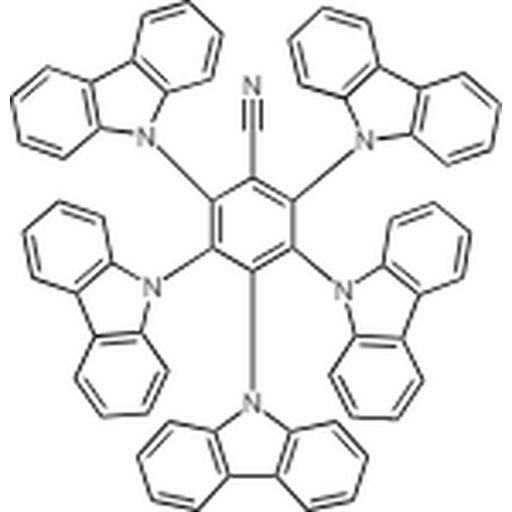
5CzBN
| Numer CAS: | 1469700-24-0 |
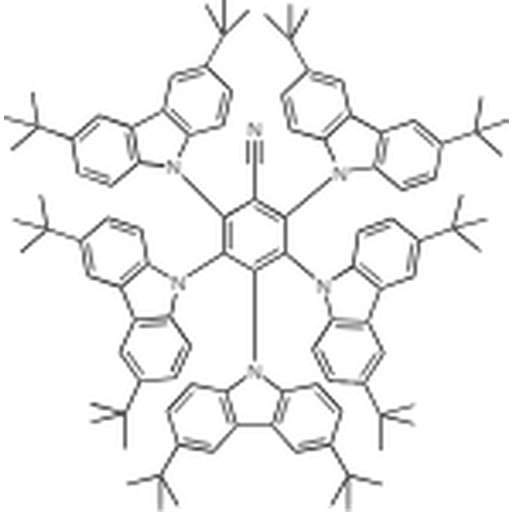
5TCzBN
| Numer CAS: | 1469700-26-2 |
![BDAVBi C52H40N2 523977-57-3 Chemical Compound 4,4′-Bis[4-(diphenylamino)styryl]biphenyl](https://noctiluca.old.semidea.pl/wp-content/uploads/2023/02/BDAVBi-C52H40N2-523977-57-3-chemical-compound.jpg)
BDAVBi
| Numer CAS: | 523977-57-3 |
OLED dopants are luminescent active compounds that serve as light emitters within the emissive layer. Their function is to convert excitation energy into light emission of a specific color, with high quantum efficiency and a controlled energy profile.
Our portfolio includes TADF emitters, phosphorescent iridium complexes, and donor–acceptor type emitters. Each class of these materials is used in OLED devices requiring precise emission color control and high efficiency.
OLED dopants are used in mobile displays, OLED TVs, microdisplays, decorative lighting, and automotive systems. Key parameters include brightness, efficiency, low operating voltage, and color purity.
TADF dopants do not require heavy metals and rely on the mechanism of thermally activated delayed fluorescence (TADF), whereas phosphorescent dopants (e.g., iridium-based) operate via triplet states through spin-orbit coupling. Both types of dopants can achieve up to 100% emission efficiency, depending on their structure.
We offer OLED dopants emitting blue, green, red, and intermediate shades (yellow, orange). Materials are available as catalog products or as part of custom synthesis tailored to client-specific projects.
Yes, many of our dopants are available as sublimed organic compounds, suitable for vacuum deposition and ensuring maximum purity and thin-film homogeneity.
We typically offer ≥99.5% purity (HPLC), and for sublimed materials, even ≥99.9%. Each product is accompanied by full analytical documentation and quality control.
Yes, our OLED dopants are designed to be compatible with a wide range of commercial and experimental hosts. We also offer support in host–dopant matching.
Of course. We supply OLED dopants in laboratory-scale quantities (mg–g) and can scale up delivery after successful application validation.
Yes, we provide custom synthesis services including the design and synthesis of dopants with specific structure, emission color, energy levels, and compatibility with defined device architectures.
We apply advanced analytical methods: HPLC-MS, NMR, UV-Vis, photoluminescence, TGA, DSC, and thin-film testing — especially for sublimation-grade materials.
Yes, many of our materials have been validated in OLED test structures. We can provide application data or collaborate with customers in evaluation testing.
The dopant determines the exact emission color, quantum efficiency, lifetime, and performance within the entire operating voltage range. The choice of dopant is critical to the quality of the display or light source.
Yes, we assist clients in optimizing the EML (emissive layer) by analyzing energy alignment, host compatibility, and the photophysical profile of the entire stack. We act as a technology partner during R&D and pilot phases.
Just contact our team. Once technical needs are defined, we will prepare a material offer, delivery options, and analytical documentation. We offer flexible cooperation terms for both R&D and industrial partners.
Błąd: Brak formularza kontaktowego.
Chcesz wiedzieć, co słychać? Zapisz się na newsletter.
©2025 noctiluca. Wszelkie prawa zastrzeżone
Zapytania ofertowe | Ogólne Warunki Umowy i Informacje dla Klientów | Polityka prywatności
Made with passion by Panda Marketing