Our approach to sublimation
At Noctiluca, we specialize in advanced sublimation services. With the state-of-the-art equipment and expertise we ensure the highest levels of purity and quality in the final product.
Noctiluca provides the expertise and resources to streamline your sublimation process effectively. How the process of the sublimation service looks like? See the detailed guideline below.

STAGE I – INITIAL QUESTIONS
To ensure we deliver the most effective sublimation service to our customers, we kindly request detailed information about the product slated for the sublimation process. If certain details are unknown or confidential, please notify us, and we’ll strive to assist you nonetheless. Obtaining a comprehensive understanding at the outset will streamline initial communication and enable us to furnish you with a tailored offer. The overall cost of sublimation is contingent upon numerous factors and varies significantly for each compound. Therefore, there isn’t a “fixed” price we can provide at this stage. For further insights, please go to our FAQs section below.
What is happening in this stage?
Upon receipt of your sublimation inquiry, we will proceed by either sending you a list of supplementary questions or our team will commence analyzing the provided information to assess the feasibility of sublimating your compound. This process typically requires a few days to complete.
What does the customer get at the end of this stage?
We will offer our assessment regarding the feasibility of sublimating a specific compound. Additionally, you will receive a detailed outline of the sublimation process that we can provide, segmented into stages. Finally, you will be presented with a commercial offer for the subsequent stage.

STAGE II – TRIAL SUBLIMATION
What is the reason for this stage?
The outcome of the sublimation process is contingent upon numerous factors, making it challenging to predict solely based on available information. Hence, it’s essential to assess how a specific compound will undergo the sublimation process in our sublimator. Conducting several tests enables us to determine the optimal process parameters, streamline timing, and provide a comprehensive offer for sublimating the entire material quantity.
What is happening in this stage
During this phase we will request the delivery of a sample of the material for sublimation, typically around 3-5g. Subsequently, we will conduct analytical tests to determine the material’s purity and thermal properties. We will then commence trials of the sublimation process, analyzing the purity of the resulting product and its yield after each trial. Ultimately, we will compile a technical report summarizing the trials and provide a commercial offer for sublimating the entire material quantity. We anticipate that this stage will likely span approximately 2-3 weeks from the receipt of the material for trials.
What does the customer get at the end of this stage?
As a culmination of this stage, you will receive a comprehensive technical report detailing the analyses conducted, sublimation yield achieved, purity levels attained, and the process parameters employed. Based on these trials, we will ascertain whether the material successfully undergoes the sublimation process and propose optimized process parameters for the remaining quantity of material, ensuring effective sublimation yield. Also you will receive our offer for sublimating the remaining amount of material and the invoice for the test phase.

STAGE III – SUBLIMATION
What is the reason for this stage?
In essence, our goal is to sublime the material and deliver to our customer a fully processed product with confirmed purity.
What is happening at this stage?
Upon receiving the material for sublimation, our team will initiate the scaling-up process based on the initial sublimation trials. We will strategize the number of batches and sublimation runs required and carry out the sublimation process accordingly. Prior to and following the process, we will conduct purity analyses of the material. Ultimately, we will consolidate all results into a comprehensive technical report and deliver the processed product to our customer.
What does the customer get at the end of this stage?
We will deliver your sublimated product along with the technical report from this phase, detailing the process parameters. Additionally, you will receive a Certificate of Analysis (CoA) confirming the final product purity. At this stage, you will also receive the final invoice for the sublimation service.
Check General Contractual Terms and Conditions and Information for Customers
Sublimation Explained
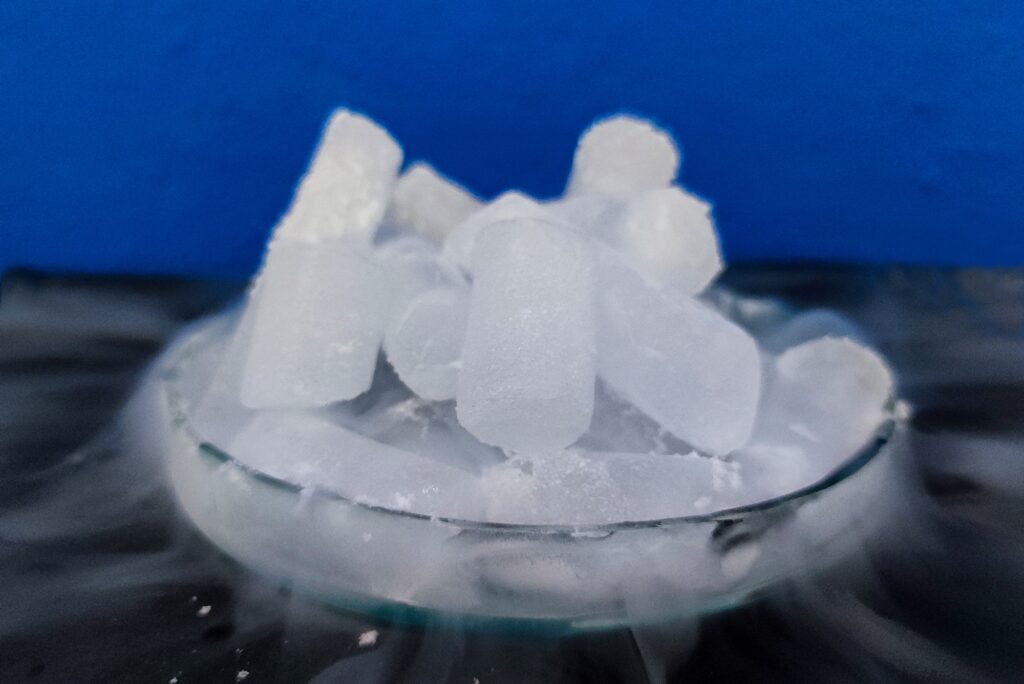
Sublimation is an endothermic process where a substance transitions directly from the solid phase to the gas phase, bypassing the liquid state. This transition occurs under specific temperature and pressure conditions, below the substance’s triple point on its phase diagram. The triple point is the threshold pressure where the substance can exist in its liquid form.
While most chemical compounds and elements exhibit three states at various temperatures under typical pressures, the transition from solid to gas often involves an intermediate liquid phase. It’s essential to note that the “pressure” in this context pertains to the substance’s partial pressure and not the system’s overall pressure. If a solid’s vapor pressure exceeds the surrounding partial pressure, it can sublimate, with some substances showing a higher inclination towards sublimation than evaporation. This inclination often arises from their elevated triple point pressures, making it challenging to obtain them in a liquid state.
The Utility of Sublimation in Chemistry
Sublimation serves as a critical technique for chemists, especially for compound purification. It’s a more efficient alternative to the time-consuming crystallization process, enabling the purification of even minuscule substance amounts. During sublimation, a solid is placed in a specialized apparatus, heated under vacuum conditions. As the pressure reduces, the solid volatilizes and condenses as a purified compound on a cooled surface, the “cold finger”, leaving non-volatile impurities behind. Once heating ceases, the purified compound can be retrieved from this cooled surface.
To maximize purification efficiency, a temperature gradient is employed. This strategy enables separating different compound fractions. Vacuum tube sublimation instruments aim to purify organic mixtures under vacuum conditions, essentially recrystallizing after evaporation. A controlled heating mechanism in an evacuated glass tube allows for distinct re-condensation points, depending on compound volatilities.
Heat absorption during sublimation facilitates the molecular transition into the vapor phase, categorizing it as an endothermic process. The heat of sublimation can be determined by summing the heat of fusion (solid to liquid) and the heat of vaporization (liquid to gas).
Problems addressed and applicability
Sublimation, particularly vacuum sublimation, is pivotal for purifying organic compounds in industries requiring purities often above 99%. This high purity is essential for consumer electronics, organic optoelectronic materials, and nanomaterial applications. Sublimation not only eliminates impurities but also volatiles, which can hinder high-temperature manufacturing processes.
Who benefits?
- Next-Generation Tech Materials: Sublimation is integral to developing materials for cutting-edge technologies. It ensures top-tier purity, promoting the efficiency of end-use applications in devices like mobiles, monitors, and solar cells.
- Academic and Industrial Synergy: Leading universities and research labs leverage sublimation services for material purification, fostering a smooth transition from discovery to practical application in advanced tech sectors.
- OLED Tech: Organic electronic technology advancements necessitate compounds with purity levels exceeding 99%. Sublimation ensures this high purity, enabling innovations like flexible OLED displays.
- Perovskite Solar Cells: In producing high-quality perovskite materials for solar cells, sublimation is crucial to improve efficiency and reduce costs.
- Pharmaceutical Industry: Our sublimation services exclude drug, intermediate product, and active pharmaceutical ingredient manufacturing due to the lack of cleanroom facilities. However, if sterility isn’t mandated, we’re open to discussions about purification via sublimation.
Frequently Asked Questions (FAQs)
1. What is sublimation?
Please read more about sublimation on this blog post.
2. Where to start and what information we will require at the beginning?
Start by emailing sales@noctiluca.eu with as much detail as possible. Use this questionnaire form to guide your responses.
3. How much does the sublimation cost?
Costs vary by compound. After reviewing your answers in the questionnaire, we’ll prepare a test phase proposal and later quote the main phase separately.
4. What will be the final purity of sublimed compounds?
Purity can reach above 99%, depending on initial purity, sublimation conditions, selectivity of the process, and proper technique. Each case is assessed individually.
5. What does the sublimation efficiency is?
Efficiency depends on factors like starting material purity, temperature control, surface area, and collection technique. Average yield is about 50%, with any extra product delivered free of charge.
6. How much time is required for the sublimation?
Initial testing takes about 2–3 weeks. Final duration depends on scale and process parameters. Quality and purity are prioritized over speed.
7. What compounds are not suitable for the sublimation process?
Unsuitable: highly reactive, low volatility, high melting point, ionic, large organic molecules, or those reacting with steel/quartz. Suitability is evaluated case-by-case.
8. What type of sublimator do you have?
A 2-meter horizontal tube in a 6-zone furnace up to 600℃, with 12 thermocouples and dual vacuum pumps (molecular & fore), allows batch sizes from a few grams to hundreds.
9. What is the sublimator’s capacity?
From a few grams to hundreds, depending on the compound’s bulk density and process requirements.
10. What is the minimum amount of compound for sublimation?
As little as less than 1 gram is acceptable for testing, but a few grams are typically needed for full process execution.
11. Do you provide a certificate of analysis?
Yes. After the main phase, you receive a Certificate of Analysis (CoA) and a technical report covering yield, purity, and parameters.
12. How to contact us in case of any other questions?
Please email sales@noctiluca.eu. We’ll be happy to assist you.